In the face of the rapidly changing, volatile and at times ineffectual labor movement, looking back can provide useful insight in understanding current challenges faced by both migrant and domestic workers. This case focuses on the establishment of a grassroots migrant workers movement in South Korea. This case is unique both in the history of migrant workers in East Asia and in the South Korean labor movement. While there were ultimately many shortcomings and failures throughout these campaigns, their significance within the region and in laying the groundwork for migrant worker organizing in South Korea make them an important case study of international labor solidarity.
While the campaigns and organizing examined took place within the borders of South Korea, nearly all of the workers lacked citizenship rights. Many were inadvertently in the country illegally due to the nature of their restrictive immigration status under the South Korean guest worker program. While the migrant workers themselves took on leadership roles, these campaigns became collective efforts between South Korean organizers, faith groups, NGOs, existing South Korean Unions, and one incidental American organizer (this case study’s primary informant). The South Korean faith organizations that were initially involved in the campaigns began delivering aid and forming workers’ collectives in Nepal after many migrant workers repatriated.
Set against the backdrop of South Korea’s democratic student movement, this case is significant in two regards. First, the protests and gains won by workers were the first of their kind in South Korea and represent some of the earliest organizing and advocacy work done by migrant workers in East Asia. Second, it provides a unique example of international solidarity in the South Korean labor movement.
Background
Throughout much of the late twentieth century, South Korea primarily exported labor and saw little to no inward migration. Several internal and external factors influenced the eventual presence of migrant workers into South Korea beginning in the 1980s. Most significant in the inflow of migrant workers was the rapid development and industrialization of the South Korean economy beginning in the 1980s, which led to a shift in the needs of the nation’s labor market. Increased availability of foreign workers interested in South Korean positions served to fill a shortage in the labor market for low wage work (primarily difficult and high risk manual labor) in medium-sized firms.
It is important to further emphasize the nature of inward immigration into South Korea prior to the 1980s. Similar to Japan, a self imposed identity of ethnic and cultural homogeneity has greatly influenced a highly restrictive modern immigration policy. Maintaining this perceived homogeneity has in turn created a hostile climate towards immigrants in the few instances of inward migration. As a consequence of this environment, migrant workers suffered very poor conditions from the outset of their admittance into South Korea. Quite literally second class, migrant workers lacked basic human rights protections, little to no social value, and were de facto restricted to the worst, most dangerous, jobs at the lowest pay scale.
As a result of this environment, many workers left their initial positions in violation of their immigration program and were at constant risk of deportation in a liminal and unstable undocumented status. All of this sets the stage for the organization of migrant workers. The organizing priority of migrant workers was access to workers’ compensation and healthcare through the state and their employers. The vast majority of migrant workers were employed in dangerous jobs with high rates of often debilitating injuries. Without legal recognition as a union, the MTU primarily utilized sit ins and demonstrations to organize and campaign around gaining access to workers’ compensation.
Two major demonstrations by the migrant workers themselves marked turning points. In 1994, migrant workers organized a twenty-nine day sit-in in the offices of the prominent NGO, the Citizens Coalition for Economic Justice; and in 1995, they participated in a nine day sit-in at the Myungdong Cathedral, a symbolic location in the Korean democratic movement. These sit-ins both established the formation of a coalition in support of migrant workers and ultimately had the effect of drawing enough domestic and international media attention to the plight of these migrant workers. As a result, “the government, recognizing a growing public concern over the problematic ITS, decided that immigrant trainees were covered by industrial accident and medical insurance and were partially protected by the Labor Standards Law, including its minimum wage provisions” (Lee & Yoo 2013).
The narrative of the Myungdong sit-down protest is recounted in a textbook for child laborers produced by the FoolWildflower collective, the successor organization to the Shelter for Foreign Workers. It is reproduced below:
13 Brave Nepalese People
1. On January 9, 1995, thirteen Nepalese workers gathered in Myung Dong a neighborhood in the center of the capital city Seoul. They chained themselves together and pleaded with Koreans: “Put our pay directly into our hands. Please do not beat us. We want to come and go freely from the factories where we work.” “We may have come from poor nations, but our very existence will not be impoverished.”
2. On July 25 of 1994 they arrived in Korea and became coworkers in the same factory. On the day before they entered Korea the Nepalese company that was sending them to Korea gathered them together. They were told that they could only be paid 210 dollars a month, much less than what they had been promised previously. They were very confused and disturbed by this news, but they were also told that if they did not go to Korea the 1300 dollars in fees that they each paid to go to Korea would not be returned to them. They could not protest and ended up in Korea because like most people they had borrowed the money to pay for these fees.
3. The problems of these workers started at that point. As soon as they arrived at the factory the owner took their passports so that they could not run away. They assumed that they were coming to learn about technology, but no one was teaching them anything about technology. They were watched by the Koreans at the factory to make sure that they did not go anywhere outside of the plant. For six months they were not able to leave the factory. They were cursed at and occasionally beaten by Korean coworkers at the factory. The Nepalese company that brought them to Korea was so worried that they might run away that the company even made sure that the workers were not paid directly and went to the factory to receive their pay for them.
4. One day a Korean at the factory dormitory came and brought the Nepalese workers one by one into a nearby room where four Korean workers beat each one of the Nepalese workers as they came in. The Nepalese workers did not know why they were being beaten. As a result of the beatings one worker had a rib broken and other his nose.
5. They decided that they could bear no more and that night they escaped from the company and took refuge at an organization called the Shelter for Foreign Workers. At the shelter they met with counselors and thought about how they could solve this problem. The situation in Korea at the time was such that even speaking quietly about this problem could result in being deported to Nepal without ever receiving any pay. These workers decided to work together to present their problem directly to Korean society and took to the streets.
6. They informed people in Korea and in other nations around the world like the United States and France about their problems through the newspapers, radio and television. Many people were interested in their problem and kept an eye on it in the news. The Korean government promised that it would regulate companies that brought workers to Korean and the factories in which they worked so that there would never be a problem like this again. By working together these brave Nepalese people improved the situation of many foreign workers working in similarly painful conditions.
The names of the 13 Brave Nepalese workers are Binood Prasad Acharya, Hom Prasad Luitel, Ganesh Pandey, Ramesh Parsasi, Bel Bahadur Thapa, Janga Bahadur Thapa, Jeevan Bujagayi, Binood Adhikari, Navaraj Phuyal, Mukda Gyem, Modu Bajagayi, Anil Dakal, and Jayasor Paudel.
“I Will Be a Happy Worker”, English ver. Vol. 2, pp. 72-73.</p>
The Shelter for Foreign Workers
The faith-based Shelter for Foreign Workers was at the center of this organization, serving as a shelter and aid center for injured and transient migrant workers at risk of deportation who lacked basic health care or workers’ compensation. This act of support prompted a “number of religious groups and non-governmental organizations” who, motivated by the conditions described and further spurred by the worker demonstrations to create “a dynamic migrant workers support movement (MWSM) to demand that the rights of these foreign workers be protected and their working conditions enhanced”(Lee & Yoo 2013). A migrant workers union, the Migrants Trade Union (MTU), emerged from this movement. Its goal was to seek the independent unionization of migrants in South Korea.
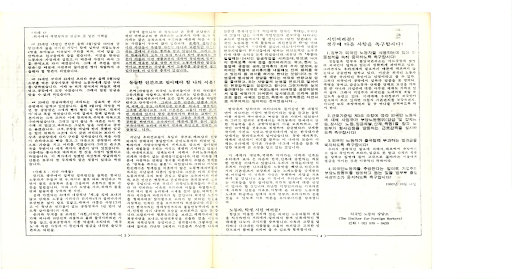
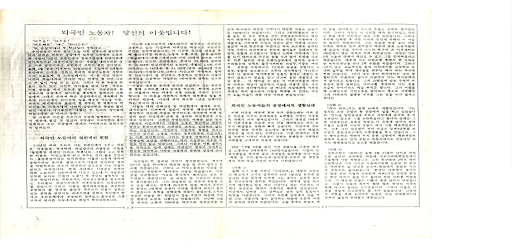
There was initial reluctance from the established labor movement in South Korea to support migrant workers in their campaigns or attempt to include them within existing unions. However, the Korea Confederation of Trade Unions (KCTU) eventually aligned themselves with the MTU and ostensibly acted in solidarity with the MWSM. This relationship was not without conflict but was an important step in building coalition support of the MTU and more effectively mobilizing attention to the organizing work of the union.
Power resources
The MTU’s campaign for workers’ compensation provides an interesting case of international labor solidarity, which is worth examining through the lens of labor power resources. Migrant workers in South Korea lacked any sort of legal protections or rights as workers or citizens, yet they were effectively able to leverage the support of institutions and the media. In addition, they ultimately succeeded in convincing the state to make significant policy changes surrounding their conditions.
From the outset, structural power was utilized by the migrant workers as their only means of asserting agency within the restrictive immigration work program of which they were a part. After their passports had been confiscated, migrant workers risked deportation by abandoning jobs that put them at constant risk of violence and injury. The admittance of migrant workers into South Korea was not a decision made lightly. These workers were filling a gap in the labor market that domestic workers refused to fill. By removing themselves from these dangerous work environments, they simultaneously disrupted their workplaces and disadvantaged their employers, while more broadly upsetting the structural solutions to labor market shortages attempted by the state. Even in the face of deportation, these workers exercised the simplest and oldest structural power move of the labor movement: withholding their labor.
Societal power was further utilized to articulate and draw attention to the plight of migrant workers in South Korea. The demonstrations and sit ins described earlier were done on a shoestring budget with practically no institutional support. However, the workers and their supporters were able to effectively use both domestic and international media to draw attention to the issues faced by migrant workers in South Korea. By cleverly leveraging media coverage into public outrage over the treatment of migrant workers, the sit-ins were ultimately successful both in securing workers’ compensation and in forcing the South Korean government to face the problematic and structurally violent immigration system they had created.
Lessons learned
Activists and organizers involved in the Shelter for Foreign Workers left us with two primary lessons to take from the work done by the organization and by the migrants themselves.
First, every little bit of work done counts and can affect the trajectory of a campaign. While the ostensible culmination of this work through the sit-ins appears rather spectacular, they were components of a complicated and often frustrating period of organizing with many moving parts and setbacks over multiple years. Countless small actions such as leafleting, networking with media outlets, and public outreach were essential in eventually forming the coalition of support and public outrage that resulted in material policy changes.
Second, control of the campaigns and organizing process needs to remain in the hands of the workers themselves. It is apparent that at certain times there were many different stakeholders involved in the organizing work, who at times did not prioritize the voices and control of the workers in their own campaign. It was stressed to us that for work like this to be meaningful, the control and decision making in a campaign or period of organizing has to rest with those who will be affected by its outcomes. With this case in particular, migrant workers already lacked any form of legal agency within the state, it was essential to ensure that they were in control of the fight for their rights and dignity.
Works Cited
Lee, B.-H., & Yoo, H.-G. (2013). The rise and fall of independent immigrant worker unionism: A case study of the Migrants Trade Union in South Korea. Journal of Industrial Relations, 55(2), 227–242.
Further Reading
Gray, Kevin. (2007). From Human to Workers’ Rights: The Emergence of a Migrant Workers’ Union Movement in Korea. Global Society. 21. 297-315.
More detailed exploration of the socio-economic conditions leading to the admittance of migrant workers into South Korea and the eventual emergence of their labor movement.
Koo, H. (2001). Korean workers: the culture and politics of class formation. Ithaca: Cornell University Press.
History of class conflict and working class conflict in South Korea.
Lee, B., & Lee, S. S. (2017). Winning conditions of precarious workers’ struggles: A reflection based on case studies from South Korea. Relations Industrielles, 72(3), 524-550.
Exploration of the conditions which allow for the success of precarious workers lacking legal legitimacy or agency using migrant workers in South Korea as a case study.
 Solidarity and Campaigns