By Chad Rosenbloom
When the now infamous Wells Fargo scandal was brought to public attention back in October 2016, it wasn’t entirely clear that the groundwork for the revelations had been laid three years before with the creation of the Committee for Better Banks (CBA) under the initiative of the Communications Workers of America (CWA).
The scandal probably would have remained a secret if it weren’t for front line bank workers speaking out regarding profoundly stressful sales goals practices that were leaving them with little choice but to push predatory financial products onto their customers and create millions of fake bank and credit card accounts (Payne 2017).
Forcing two Wells Fargo CEOs from their posts and costing the company billions in fines, the CWA strategically leveraged its community partnerships to reign in a major financial player and sent a message to other banks engaging in the same unacceptable business practices.
Acting under the notion of “bargaining for the common good,” the CWA through its community/international partnerships has sought to push for “regulation from below” that will raise standards in the banking industry and usher in shared prosperity for the employees that make banks work.
Case Description
This effort to push back against the excesses of finance capital is rooted in an inspiring campaign to organize bank workers in the United States, a project that crystallized under the initiative of the Brazilian bank workers union, SEEB-SP, and UNI Global Union – Finance. Partnering with Service Employees International Union (SEIU) Local 26 and the CWA, SEEB-SP sought to spearhead an organizing drive of rank-and-file bank workers in the country that contains 1/3 of the world’s financial workers but virtually no union representation.
Bank workers in Brazil identified the lack of organization in the US’s financial sector as, “a threat to the historic gains of social movements everywhere” (Payne 2017). This marks an interesting example of a foreign union proactively seeking to improve working conditions and regulatory deficiencies in the US. Stephen Lerner has commented that this campaign represents, “perhaps the first time in…history…where foreign unions have been the driving force behind launching an organizing drive in the US” (Payne 2017).
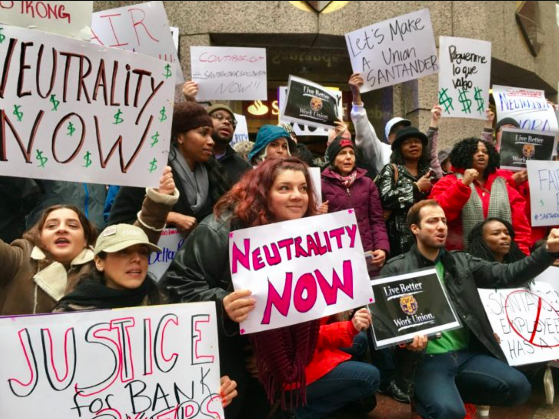
The organizing drive dates back to 2010 when the SEIU facilitated protests in New York against Banco Santander, a Spanish-based bank that has established numerous locations in the domestic United States. With the emergence of Occupy Wall St. in 2011 reflecting growing public anger against the big banks and their prominent role in the collapse of the global economy in 2007, the CWA also made a determination that taking on the greed of Wall St. should be a primary organizing concern. The CWA has sought to organize customer service representatives, collections agents, and bank tellers to improve pay and working conditions as well as to facilitate greater accountability for finance capital.
The CBB was formed in 2013, a broad-based initiative of the CWA comprised of unions, worker centers, community-based organizations, and consumer advocacy groups. As noted by Emma Cusumano, the CBB since its inception has, “arranged protests, released research reports, ‘crashed’ shareholder meetings, and organized in workplaces across the country” (Cusumano 2018). The organization has been on the front end of the movement to organize bank workers in the US and raise standards in the industry as a whole through strategic minority campaigns, advocacy, and community pressure tactics. Their first targets have been foreign-owned firms.
According to a CWA representative, “The international solidarity has been pretty incredible. We even had workers in Brazil and Argentina that made organizing rights in the US a demand in their strikes, which was pretty amazing.” Banco do Brasil opened branches in the US and signed an agreement with SEEB-SP recognizing US workers right to organize (Payne 2017). In May 2015 a delegation of Brazilian workers from Banco visited Orlando to aid in an organizing drive.
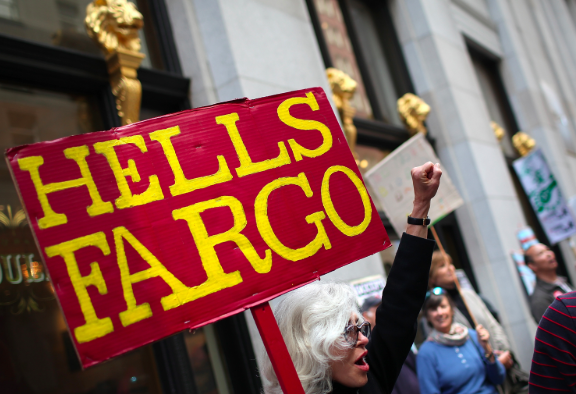
One of the more significant victories of the coalition to date has been exposing Wells Fargo for its oppressive sales goals practices that led its employees to set up numerous fake accounts and dishonestly push financial products on their customers. Employees created well over 3 million of these accounts since the early 2000s.
The practice was only uncovered when frontline workers decided enough was enough and brought the scandal to the attention of the Los Angeles Times (Meyerson 2018). The fact that the CBB was primarily behind this and in the process forced two Wells Fargo CEOs demonstrates the importance of the grassroots for fiscal reform, “Our members were on the front page of the New York Times, they were on the second or third page of the Wall Street Journal, they were on the nightly news,” said the CWA representative. “They were really the ones who broke this and I think it’s a testament to the fact that it’s not just whistleblowers, that it’s actually workers coming together in an organized way with the power of their communities and the power of a union that can actually change the industry.”
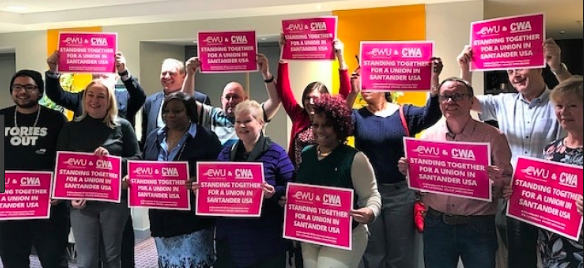
There have also been interesting developments in the effort to organize Santander. Union protestors successfully shut down the company’s headquarters in Boston in March 2017 and sought a neutrality agreement from management. This was shortly after CBB had issued a report documenting the bank’s allegedly discriminatory mortgage lending practices (Johnston 2017).
Targeting Santander from the beginning has been well-considered strategic move: The bank has been struggling to establish a foothold in the US and is heavily unionized in its operations elsewhere. Foreign-owned companies that are accustomed to bargaining with strong labor unions in their home countries might be more amenable to organizing drives in the US. The CWA representative explained:
“International banks that are based here and have a workforce face more regulatory hurdles, they’re more vulnerable to pressure, and are also unionized in most of the world. So they have had relationships with unions and seen that things haven’t fallen apart by having a union. We think we have more of an opportunity to organize international banks here in the US first.”
More often than not these firms, usually under the influence of American legal counsel, try as hard as possible to abandon their customary good relations with labor unions as they establish operations here. The UAW has encountered similar problems in its organizing campaigns against so-called “transplant” auto factories owned by foreign companies in the South (Meyerson 2018).
Similar to how the Chicago Teachers Union engaged community outreach by targeting parents and community organizations, the CBB has strategically taken advantage of the public perception that virtually unaccountable financial institutions need to be reined in order to avoid or mitigate another crisis. The campaign has been successful not just in bringing to light the unacceptable business practices of actors like Wells Fargo but has also helped to raise standards for the wider industry bit by bit. Most major financial institutions have raised their minimum wage to $15/hour or more, both due to the efforts of the CBB and the Fight for $15 campaign.
Stephen Lerner, Rita Berlofa, and Molly McGrath have written, “From day to day, millions of employees make banks work, and frontline workers can make banks better. Instead of solely relying on legal and supervisory systems to take on the entire task of financial ‘regulation from above,’ employees can collectively assist in ‘regulation from below.’” Although collective bargaining in the financial sector remains a far-off prospect, the CWA, UNI Global, and their community partners are engaged in an impactful struggle to leverage resources domestically and internationally to make this a reality.
As the CWA representative pointed out, “We’re seeing how Wall St. is robbing our municipalities, our subways, our schools, and our families with bad mortgages, predatory auto loans, credit card and overdraft fees. Bank workers are at the front line of that. If they have job security, and we’re able to create a space where they can speak out about this, we think that can improve things for the entire working class and definitely help take on on Wall St.”
Analysis of Power Resources
This case reflects some very promising and innovative dynamics for union and community organizers. On the one hand, we can see a very powerful and longstanding trade union presence in Brazil’s financial sector that has a strong tradition of social movement activity. Recognizing the need to organize workers within the US in reaction to the financialization of the global economy and resurgence of reactionary political forces, these unionists leveraged their relatively powerful position in their own polity to spearhead a campaign in a foreign country.
The capacity of UNI Global to serve as a bridge between organizing campaigns and unions in various countries also reflects a strategic advantage on the world stage. By establishing or seeking to establish “global framework agreements” with multinational corporations (MNCs) that would ensure basic standards in their operations around the world, UNI Global can put pressure on these companies to respect freedom of association in anti-union strongholds like the United States. A representative from UNI Global – Finance, states:
“BNP Paribas [Bank of the West] has a bank in the US that is bigger than the Santander operation, and we thought that making the global framework agreement would serve as good leverage to achieve what we are fighting for, that is, to allow the workers of Bank of the West to be organized in a trade union. This is leverage because it is not clearly stated that the bank is neutral but it is also not clearly stated that the bank is against the rights of workers to be organized. We are using this to our advantage.”
According to both the CWA and UNI representatives, it remains to be seen which way US managers of these MNCs will go but the pressure is certainly on. One problematic aspect is the fact that management at Wells Fargo and other US banks are most likely strategizing with these foreign firms as to how they can avoid any “inroads” for organized labor in the financial sector. It’s worth noting that Santander currently doesn’t have a global framework agreement with UNI Global, and thus the prospects for CWA and its community partners to have good relations are somewhat more difficult than with BNP Paribas. According to the CWA representative:
“We’re using the global framework agreements and our relationships with UNI Global Union to push the French [BNP Paribas/Bank of the West] to push the US, but then also making sure that none of these banks feel like they’re going to be the only one. The same way we’re attacking Wells Fargo, workers speaking out about the injustices there, that’s happening at Santander, that’s happening at Bank of America, and that will continue to happen until workers have an organized way of doing that.”
Using the international reputations of the MNCs to their advantage is something both union representatives mentioned as one way forward. By pressuring companies through global framework agreements that are accustomed to the “social dialogue” to be the “good bank,” to stop pushing predatory financial products and respect workers’ rights, UNI Global and its partners in the US and elsewhere can potentially compel MNCs to adopt a more socially responsible posture regarding their US workers’ right to organize.
Unions in the US financial sector in particular and in the economy more generally suffer from incredibly low density and political clout. In part due to significant pressure from Brazilian unionists, the CWA embarked on a campaign of intensive community outreach and sought to establish working relationships with community organizations under the umbrella of the CBB.
This represents an effort to effectively leverage and mobilize societal power in lieu of having a strong presence in the financial sector. The CWA is in a unique position to be a major player in this campaign given their unusually strong (compared to many other unions) associational power and their structural power in certain other customer service occupational groups. As a union with some relative power in the American labor regime, the CWA was able to devote significant resources to the campaign and facilitate the creation of the CBB.
The decision of the CWA to try and leverage societal power and build a broad-based coalition of actors beyond the workplace reflects a very sound strategic program. Since the collapse of the global economy in 2007 due to reckless investment and predatory lending practices, public opinion has been situated pretty firmly against the big banks. By taking advantage of the paradigm shift induced by the Occupy Movement and the ensuing years of activism it helped to inspire around workers’ rights, environmental justice, police violence, and fiscal reform, the CWA, UNI Global, and their coalition partners have laid the basis for future organizing in the US financial sector.
Lessons Learned
- Collective action threatens even the most powerful and entrenched business interests.
- Strategically taking advantage of shifts in public opinion can make all the difference in organizing campaigns.
- (i.e. financial crisis produced widespread public animosity against the big banks – CWA leveraged this to start organizing and advocating for bank workers).
- General lack of power and resources can be compensated by community engagement.
- It is not unprecedented for workers in the Global South to take an interest in North American working conditions.
- Transnational partnerships can be mutually beneficial.
- Workers cannot “go it alone.”
- Neo-liberal restructuring is a global phenomenon and effectively combating it requires transnational solidarity.
- Solidarity and self-interest can reinforce each other.
- The Brazilian bank workers have demonstrated how it is simultaneously in their self-interest to organize the financial sector in the United States while also principally being an act of solidarity. Declining standards in the latter country negatively affect workers everywhere.
- The construction of broad-based coalitions of unions, worker centers, community-based organizations, and other social movement actors is an innovative and necessary project for the 21st century labor movement.
- Collective bargaining isn’t always the most feasible or strategic aim to shoot for.
- The CBB campaign, the Fight for $15, and many of the recent teacher strikes illustrate that there are many innovative ways unions and their allies can improve economic standards.
References
Payne, Steven. “National Unions, International Capital, and Bank Workers.”Uncertain Times: Anthropological Approaches to Labor in a Neoliberal World, edited by Paul E Durrenberger. University Press of Colorado, 2017, pp. 252-266.
Harold Meyerson. “Bank Workers Rising.” The American Prospect, 17 July 2018, online.
Cusumano, Emma. “Regulating from the Ground up: Controlling Financial Institutions with Bank Workers’ Unions.” U. Rich. L. Rev. 53 (2018): 733.
Katie Johnston. “Activists briefly occupy Santander Headquarters in union campaign.” Boston Globe, 27 March 2017, online.
Further Reading
Since its inception in 2013 that CBB has published several reports documenting the conditions of frontline bank workers, fraudulent and high pressure business practices by big banks, and the job priorities of the major banks in the US financial sector. You can find these reports on the CBB website.
For more information on the CWA’s campaign to organize bank workers in the United States see the CWA Bank Workers campaign website.
For more information on UNI Global’s role in the campaign to organize bank workers around the world see the UNI-Finance campaign website
For a closer look on how the CBB effectively exposed the Wells Fargo scandal see this article in the American Prospect by Peter Dreier. Publicly available:
Dreier, P. The Feisty Group that Expose Wells Fargo’s Wrongdoing. American Prospect, 13 April 2017, online.
For are more detailed analysis of the course and character of the bank workers campaign and its implications for future organizing, check out the piece cited below. The authors identify five “principles” on which the campaign has been based and argue that for continued success these must remain central to the program: (1) “global solidarity in order to challenge global capital, (2) “global and national transformation and reform of finance, (3) “building community support and supporting communities, (4) “industry-wide organizing approach, (5) “collective bargaining, regulating, and reforming finance are intertwined.”
Sheikh, Hina, Stephen Lerner, and Rita Berlofa. (2016) “Organizing the US Financial Sector: Industry Reform and Raising Labor Standards Through Transnational Alliances.” INEQUALITY, UNCERTAINTY, AND OPPORTUNITY (2016): 119.
In this piece, labor scholar Joseph A. McCartin outlines the concept of “bargaining for the common good” as it has evolved and influenced labor/community organizing initiatives:
McCartin, Joseph A. Bargaining for the Common Good. Dissent 63.2 (2016): 128-135.
 Solidarity and Campaigns